Fire Lesson 1
Fire Prevention And Protection
We are all aware of the dangers and potential hazards associated with our line of work, related to our industry. Dealing with fires may happen to you once or twice but it is important that you know how to use a fire fighting equipment. This unit standard could save your life and the lives of your family and fellow employees. Firefighters’ goals are to save life, property and the environment.
There is legislation in place that requires an employer to provide adequate fire extinguishers/ equipment in the workplace. Legislation includes:
- Occupational Health and Safety Act, 1993,
- Environmental Regulations (Reg 9)
The Occupational Health and Safety Act defines the workplace as any premises or place where a person performs work in the course of his/her employment
One of the potential hazards that we need to be aware of, and must ensure that we are ready and competent to handle, at any time, is how to . . .
- Identify potential fire hazards
- Take preventative action to prevent a fire
- Raise the fire alarm in the event of an emergency
- Retain a fire
- Extinguish a fire
For us to be able to deal with any of the above aspects of fire fighting and control, we need to understand a few different things, such as:
- The chemistry of fire
- Methods of extinguishing a fire
- General sources of fire ignition
- Good housekeeping to prevent potential fires
- Classification of fires
- Fire extinguishing mediums
- Fire fighter rules
Some rules for preventing fire
- Don’t play with matches.
- Don’t leave paper, oily rags or other rubbish in closed rooms, cupboards or in the vehicle. Remember spontaneous combustion.
- Check extension cords to electrical appliances, and replace any that are frayed.
- Be very careful with paraffin stoves. Don’t dry wet clothes near them or near open fires.
- Never pour petrol or paraffin onto an open fire – not even before lighting it.
- Never leave camp fires unattended.
- Never throw away cigarette ends or matches.
Fire fighting strategy
In order to fight a fire effectively, you need a fire fighting strategy that involves the following basic procedures:
- arriving at the scene of the fire as rapidly as possible;
- assessing the nature of the fire by determining its intensity and extent,
- the type and abundance of fuel, the danger of entering the fire area,
- and the most effective techniques for extinguishing the fire;
- locating and rescuing endangered persons; containing the fire by protecting adjacent areas;
- ventilating the fire area to allow for the escape of heat and toxic gases; and,
- finally, extinguishing the fire.
Fire Fighting Teams
Company fire-fighting teams are primarily composed of volunteers, or “vols” within the company. Fire-fighting teams also help design and implement fire-prevention programs, which may include such measures as building codes requiring fire alarms, regularly located fire-extinguishing equipment, internal fire walls to help contain a fire, sprinkler systems, the use of fire-retardant construction materials, and safe electrical wiring.
At a fire, a team performs necessary rescue operations, protects nearby areas, and oversees salvage work, as well as containing and extinguishing the blaze.
Check equipment
- Ensure all fire equipment is readily available.
- Check all extinguishers – not to be damaged in any way.
- Storage areas for all fire equipment to be clearly marked and free from any obstruction.
- Ensure correct placement of fire equipment.
- Check for main electrical switch and fire alarm button.
- Ensure that you know the fire drills of the company and the alarm system.
Fire fighting and safety equipment
Fire fighting equipment includes:
- Fire extinguisher
- Fire buckets
- Fire hoses
- Sprinkler system
Safety equipment includes:
- Breathing apparatus
- Fire blankets
- Protective clothing
- Heat shields
As with any equipment we need to ensure that the equipment are in a good working order. Outlined below are the checks that we should do on a regular basis.
| IDENTIFY & USE | CHECKS |
| Fire extinguisher – used to extinguish or contain small fires. | Safety pin in place and sealed
Gage – Red or Green Condition of hose (perished) Date of service (12 months) Nozzle – condition, not blocked General – Corrosion or damage Unobstructed Signage – extinguisher, wall |
| Fire buckets – used to through sand or water on fires. | General – Corrosion or damage
Unobstructed Signage – extinguisher, wall |
| Fire hoses – used to extinguish large fires. | Safety pin in place and sealed
Gage – Red or Green Condition of hose (perished) Date of service (12 months) Nozzle – condition, not blocked General – Corrosion or damage Unobstructed Signage – extinguisher, wall |
| Breathing apparatus – used when there is a lot of smoke, normally in a confined space. | Clean
Cuts Correct fit Fit for purpose |
| Fire blankets – used to throw over a person who burns or on a burning object. | Clean
Cuts |
| Protective clothing – fire/heat repellent. | Clean
Torn Correct fit Fit for purpose |
| Heat shields – repels heat away from fire fighter. | Clean
Damage Fit for purpose |
Buildings are protected against fire most effectively by protective sprinkler systems. In most sprinkler systems, water circulates through overhead pipes whose outlets are normally closed; at high temperatures the outlets open, spraying water on the fire.
Most large buildings also provide water for fire fighting through a standpipe system with hose connections on each floor.
Both the sprinkler and standpipe systems must be inspected by the Fire department annually. Report any broken seals immediately.
Problems that may cause fires and hamper fire control
Definition of housekeeping:
A place for everything and everything in its place
Good lighting.
Good ventilation
Hygiene facilities to be kept clean
All aisles and storage area clearly marked
Good stacking and storage practice
Good stacked must not endanger life
Factory yards must be kept tidy
All refuse to be placed in bins
Poor housekeeping
Unnecessary rubbish, waste and vegetation in the yard
Poor stacking/storage practices
Unsafe handling of flammable liquids
No compartmentalization of large areas
Materials with a high fire risk and materials that react chemically to one another are not stored in separate compartments.
Compartments not kept in good condition.
Lack of control over “hot work”
(Work where some kind of heat is used to carry out the task)
There is no hot-work permit system
Permit systems are not implemented correctly
Handling of flammable and hazardous materials
Unsafe transport practices.
Too many flammable liquids handled at a time.
Tests for explosive atmospheres not done.
Lack of ventilation.
Inadequate storage facilities.
Poor maintenance of equipment and machinery
Not regular inspections.
No safety standards.
Responsibility for maintenance has not been determined.
No maintenance program.
Too little or unusable fire-fighting equipment for fires
Wrong sighting of fire-extinguisher equipment.
No fire extinguishing equipment.
Wrong type of fire-extinguisher equipment.
No maintenance program.
Defective or ineffective program for fire prevention and fire-fighting
No fire prevention inspection, fire teams, training in fire fighting or fire drills.
No or poor knowledge of the fire alarm.
No fire alarm.
Poor action taken during the identification and extinguishing of a fire
No training in fire fighting.
Limited knowledge of emergency procedures.
Incorrect use of fire extinguishing equipment.
Electricity.
Chemistry of fire
In less than 30 seconds a small flame can get completely out of control and turn into a major fire. It only takes minutes for thick black smoke to fill a house. In minutes, a vehicle/house can be engulfed in flames. Most fires occur in the home when people are asleep. If you wake up to a fire, you won’t have time to grab valuables because fire spreads too quickly and the smoke is too thick. There is only time to escape.
Fire is a chemical reaction known as combustion that occurs when fuel and oxygen are brought together with enough heat to cause ignition.
These elements are required to cause and sustain a fire, should any of the required elements be removed the triangle will collapse therefore combustion will cease.
Each of these elements is explained as follows:
Fuel
Fuel can be any combustible material, solid or gas. Most solids and liquids need to change into gas before they will burn.
Examples of fuels
| Solids | Liquids | Gasses |
| Paper, wood, cloth, rubber, plastic, leather, wax and grass | Petrol, paraffin, alcohol, paint, oil and varnish | LPG, butane, acetylene (found in nail polish remover), propane and hydrogen |
Oxygen
The air we breathe consists of 21% oxygen (0²).
An atmosphere of at least 16% oxygen (0²) is needed to sustain a fire.
In the process of burning, a fire consumes oxygen. It is therefore possible for a fire to use up all the oxygen in a closed space. When all the oxygen is used up – no fire!
BEWARE: a smoldering fire can re-ignite when exposed to air (oxygen). Do not open doors and windows until it is safe.
Heat / Ignition
Heat is the energy necessary to increase the temperature of the fuel to a point where sufficient vapours are given off for ignition to occur.
A critical temperature must be reached for any fuel to vaporize and ignite. Once a fire has started, it will generally maintain its own heat supply. Heat is also called source of ignition.
Heat can be defined as ignition or continuous heat. Normally ignition heat is from an external source as stated in the example on the next page.
The only time that ignition heat is not from an external source is when spontaneous combustion takes place. Examples of these heat sources are the mixture of chlorine and break fluid or chlorine and coke. After ignition, the external source does not play a role in generating further heat. An existing fire generates its own heat.
| Chemical heat | Electrical heat | Mechanical heat | Solar/radiation heat | Nuclear heat |
| This is generated by mixing chemical substances | Overloading of an electrical conductor | Friction of two surfaces moving against each other or
Compression of gas in a cylinder |
The concentration of heat sends out rays | This is generated when atoms are split. (controlled at power stations.) |
Chemical reaction
A chemical reaction can occur when the above three elements: fuel, oxygen and heat, are present under the right conditions and in the proper proportions. Fire occurs when this rapid oxidation or burning takes place.
Since fires can be prevented by keeping these ingredients (elements) separate, we keep combustible materials (fuels) away from hot equipment and make sure that flames from welding torches do not get into contact with grease or oil.
Extinguishing is an attempt to . . .
smother (remove oxygen)
quench (interfere with chain reaction)
starve (remove fuel)
cool (remove heat) a fire.
Some types of extinguishing media make use of a combination of these methods.
Rules of the fire fighter
Check that the fire brigade has been summoned.
Ensure that the fire brigade is received at the entrance to the premises and directed to the fire.
Ensure that the sprinkler control valve is open and remains open until the fire is under control.
A member of the team should be familiar with steam water and fuel pipes. It would be his duty in the event of a fire to shut off all flammable liquid and gas supplies in the vicinity of the fire.
The team should, if possible include an electrician who is conversant with electrical installations throughout the plant.
If A Fire Has Been Burning for A Long Time
Call the Fire Department
Tip Find out what the emergency telephones numbers are for the area you are working in at the start of the project . . . And not . . . Once it is too late
When You Make That Important Emergency Call
How to alert the Emergency Medical Services:
If somebody arrives to assist you, ask him/her the following:
Do you understand Afrikaans or English?
Do you know anything about first aid?
Please phone the Emergency Services on ………………………………
As soon as you get through to the E.M.S. state your name and telephone number and from where you are calling.
Supply them the reason for calling, (Coking, C.P.R. Severe bleeding, Unconscious etc.)
Supply your exact address with landmarks and nearest crossroads.
Find out operators name and ask the operator to repeat the address, so that you know that he knows where to send the ambulance.
Never replace the receiver of the telephone first always wait for the operator to end off, as this will ensure the rapid response and arrival of the ambulance.
Do you understand? What is the number?
Are you able to make a call?
Come back to me and report.
Please hurry!!
If Nobody Arrives To Assist You, You Must Do The Above Procedures By Yourself. Make sure that . . .
You give your name & number
Explain what is burning (house, car, factory)
You give the address / Landmark / Nearest cross road etc.
You point out any possible complications (20th Floor, chemical spill etc.)
You take the operators name, and ask him to read back the address
You let the operator end the conversation and not just cut them off
You report back to your fire co-ordinator and await new orders
Remember . . . Your life . . . And others lives . . . Are much more important than property!!! Always consider your own safety first
The Three “B’s”
“B” AWARE
“B” ALERT
“B” CAREFUL
DO NOT . . .
“B” SORRY ???
Prepare for an emergency
The first step is to find out what the emergency telephones numbers are for the area you are working in and to make sure that every health and safety representative has the numbers available.
The numbers should also be given to all the department and section heads and should be displayed in prominent places all over the workplace.
The national emergency telephone number is 10177
- Make sure the fire escape routes are safe
- Make sure that emergency evacuation plans are in place
- Install an alarm system
- Train the staff, especially the fire marshals
Employers should
Post fire escape plans in a prominent location (notice boards, toilets and change rooms) on every level.
Ensure all employees are familiar with exit locations; escape routes and fire extinguisher locations.
Conduct regular fire drills.
Post the emergency numbers on or near all telephones.
Make provisions for safe evacuation of employees with disabilities by appointing someone to assist them.
Appoint and train a fire warden on each level of the building to ensure safe evacuation and ongoing safety programs.
Employees should
- Know the location of all building exits.
- Know the location of the nearest fire alarms and how to use them.
- Count the doors or desks between their work area and the nearest exit. During a fire, exit signs may not be visible due to smoke or a power failure
Emergency evacuation and fire fighting signs
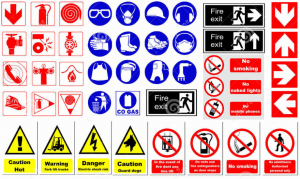
The following symbols/pictorial/signs is used by companies to indicate fire evacuation procedures or fire fighting equipment.
Emergency procedures
The Building Warden
ü On hearing or being notified that the fire alarm has operated, proceed to the Main Emergency
ü Control Point (MECP) or the Fire Board and operate the alert signal.
ü Ascertain the source of the alarm.
ü Liaise with Floor Wardens.
ü In the event that evacuation is decided on, operate the evacuation signal.
ü Decide which assembly point to use, and instruct Floor Wardens to inform occupants as they evacuate their areas.
ü Instruct switchboard operator to notify the Fire Brigade by telephone of location, size and type of fire.
The Floor Wardens
On hearing or being notified that the fire alarm has operated:
ü Proceed to their designated emergency control point.
ü Contact or report to the Building Warden at the MECP.
ü If evacuation is carried out, sound the “alert” alarm, and enter each accessible room and advise occupants to evacuate the building. Close all doors whilst progressing through the floor or area.
ü Report to the Building Warden at the MECP or Fire Board when the floor has been evacuated.
ü Following self evacuation assist other Wardens at stairway exits and/or assembly points.
The Maintenance Superintendent
ü Report to the fire board on being advised of the emergency situation.
ü Adjust building ventilation where obviously necessary or instructed by the Fire Brigade.
ü Be prepared to isolate services.
ü Reset the ventilation after automatic cut-out resulting from activation of the alarm system.
The Security Staff, on activation of the fire alarm
ü Inform the Switchboard Operator of the building affected.
ü Direct the Fire Brigade or other emergency services at Central Control to the fire or emergency location.
ü Seek out the Building Warden at the MECP or fire board and be available as a communication channel.
The Telephone Switchboard Operator shall:
- On notification of activated fire alarm: Notify the Maintenance Superintendent.
- On notification of an actual emergency: Notify the following personnel, giving location and extent of fire if known:
ü Central Control
ü Building Warden of the threatened building, or Deputy Building Warden.
- If the emergency involves fire, ring the Fire Brigade on 10111 giving location and details of fire if known.
ü Maintenance Superintendent.
ü Safety Officer
- Be prepared to pass messages from the emergency area to the Fire Brigade or other emergency service while they are on their way.
- In an Emergency Evacuation Drill, take no action other than responding to telephone enquires.
Evacuation procedures
Each organisation must have an emergency evacuation plan.
Emergency management committee
The purpose of the committee is to work out an evacuation plan for every department and/or floor of the building.
The aim of an emergency plan is to prevent death or injury in emergency situations by having a plan in place. If there is a plan in place and the plan has been rehearsed regularly, the people who have to evacuate the building will not panic and cause a stampede. This is the only way to make sure that everyone can be evacuated safely.
Important notes:
ü Emergency plans must be practiced regularly, at least every six to twelve months
ü New appointments/occupants must be informed and orientated about the plan
ü All emergency teams must be trained
ü Revise or update the emergency plans regularly and definitely when changes are made to the structure of the building.
ü The plan must give enough information so that everyone knows what they must do in an emergency, e.g. if the alarm goes off where must each group gather to wait for further instructions.
Floor wardens
All the people in the building must be evacuated through different routes, to make sure that one route does not become overcrowded.
Once the plan for the different floors or departments has been developed, a floor warden must be appointed. In the case of an emergency the floor warden must control and co-ordinate all the people present on the floor, including visitors, before evacuation. S/he must
ü make sure that everyone on the floor is accounted for,
ü must be aware of anyone in his/her zone who is pregnant or has disabilities
ü must be aware of elderly people
The floor warden must appoint someone from the group beforehand to assist these people when evacuation takes place.
Fire fighting teams
This is a team that consists of at least three members for each zone. They must be trained in fire fighting.
This team will be responsible for the initial fire fighting actions on their floor or zone. They will also be responsible for fire prevention in their zone as well as the regular inspections of fire fighting equipment and to keep inventory and inspection reports.
First aid team
At least three members who have been trained in first aid. They will be responsible for giving first aid in case of injuries.
Evacuation team
People who are on the evacuation team must know the building and the evacuation plan very well. They must also be able to control people.
This team will be responsible for the evacuation of all the occupants and visitors. They will leave the building last after they have checked that all doors and windows are closed.
Once the evacuation has taken place, the evacuation team must assemble the groups of people and make sure that everyone is present and accounted for. If there were any injuries, the evacuation team must notify the necessary emergency personnel.
The floor warden must also report to the committee that his/her group is accounted for and advise them of any injuries.
Monitoring team
Their purpose is to monitor the exits of the building during evacuation.
Guidelines for the emergency plan
What type of emergency do you expect?
ü Fire
ü Bomb scare
ü Interruption of services such as water and electricity
ü Stay away actions
Information: the action plan must have enough information for everyone to know exactly what must be done in an emergency
Communication: does the building have an intercom system, alarm system, cell phones, whistles, etc
Telephone numbers: all emergency telephone number must be available:
ü Fire department
ü SAPS
ü Ambulance
ü Hospital
ü Doctor
Personnel information: telephone numbers, next of kin and contact numbers, etc.
Floor plans must show escape routes, fire and first aid equipment, dangerous substances, problem areas, gathering pints, etc.
Who are your neighbours so that you can inform them if there is an emergency
Emergency numbers
SAPS 10111
Vodacom and MTN 112
Emergency services 10177
If a Fire Occurs
- Sound the alarm and leave the building immediately, closing all doors behind you. If you have been trained as a fire fighter, you must try to extinguish the fire but if it is to big then exit the building and join up with the other fire fighters.
- Follow the route for your group as determined in the evacuation plan.
- If smoke blocks your primary exit, use another one. If you must exit through the smoke, stay low by crawling on your hands and knees. Help the injured and lead others to the exits.
- Check doors before opening them. Kneel or crouch at the door, reach up and touch the door, knob and frame. If you feel warmth on or around the door, use another escape route. If the door feels cool, open it slowly and carefully with your shoulder against it. Slam the door shut if you see flames or smoke on the other side.
- Call the local emergency number, no matter how small the fire appears to be.
- Follow directions from fire and security personnel. Once outside, move away from the building to the designated meeting location, out of the way of fire fighters. Here roll call will be held to determine if anybody is missing. Remain outside until the operations manager or the fire department says you may go back in
- If you are trapped in a fire: stay calm, close all doors and windows, attract attention by calling out for help or use a phone. Do not break windows as oxygen will be added to the fire and may make the fire worse.
How to alert the Emergency Medical Services
Alerting the emergency services or telephoning for the fire brigade during a crisis situation can turn out to be a very complex procedure, unless a pre-plan is made, as to how you go about reporting the necessary facts and information.
By making use of a systematic approach, the information can be reported in a “to the point” manner without wasting any time or causing any further confusion, which enviably is present during emergency situations. As a First Responder you must know your local fire department’s number and have this number clearly marked on all telephones at work and at home.
The emergency scene
The First Responder (the person who is first at the scene) should protect him/herself from injury and death, since an injured or dead First Responder is useless to any emergency situation or victim/patient.
In order to prevent mishap the First Responder must always remember to first observe the scene to determine of danger exists and if additional help (i.e. fire department) is needed, before attempting to provide assistance.
First and foremost identify the presence of hazards. Then identify, if possible, the cause of the emergency and the immediate environmental dangers.
Are you as a First Responder trained and able to handle the particular hazards that are found on the scene? If not, The First Responder must call for the appropriate trained personnel to deal with the problem.
Remember the First Responder should never endanger him/herself.
The following are possible hazards that may be encountered in the field:
ü Fire or the potential of the fire.
ü Hazardous materials – chemicals, gases, etc.
ü Traffic.
ü Weather.
ü Hostile bystanders – riot and other similar situations.
ü Electricity in a dangerous capacity – leakage etc.